Last year, we announced the public preview of search and vector search capabilities for use with MongoDB Community and MongoDB Enterprise Server. Today, we are releasing the engine that powers those capabilities, mongot, into public preview under the Server Side Public License (SSPL).
This opens up a core MongoDB technology to the community and unifies MongoDB’s search architecture across self-managed deployments and MongoDB Atlas. We believe an open development approach leads to more valuable, robust, and secure software, and it directly enables a stronger community and better products.
What is mongot?
mongot is an indexing and query execution engine designed specifically to power MongoDB Search and Vector Search. When we set out to build Search, we had three core design principles:
Ensure a frictionless developer experience
Leverage battle-tested technology
Don't disrupt transactional workloads
mongot is deeply integrated into the MongoDB architecture, allowing users to manage and query search and vector search indexes natively through their applications, MongoDB Compass, or any other standard way of connecting to MongoDB using their existing connection string. $search, $searchMeta, and $vectorSearch compose naturally with other aggregation pipeline stages.
Apache Lucene provides mongot with the specialized data structures required for performant, feature-rich search and vector search capabilities, integrated into MongoDB’s operational database.
mongot builds and maintains these compute-intensive indexes outside of the transaction commit window by leveraging change streams to asynchronously replicate changes to source data, allowing customers to add search and vector search capabilities without fear of impacting existing transactional workloads.
When mongod, the core database process already available under SSPL, receives a $search, $searchMeta, or $vectorSearch query, it proxies the request to mongot to execute the query leveraging the data stored in its indexes, and returns the results to mongod. mongod then processes the rest of the query similarly to any other aggregation pipeline.
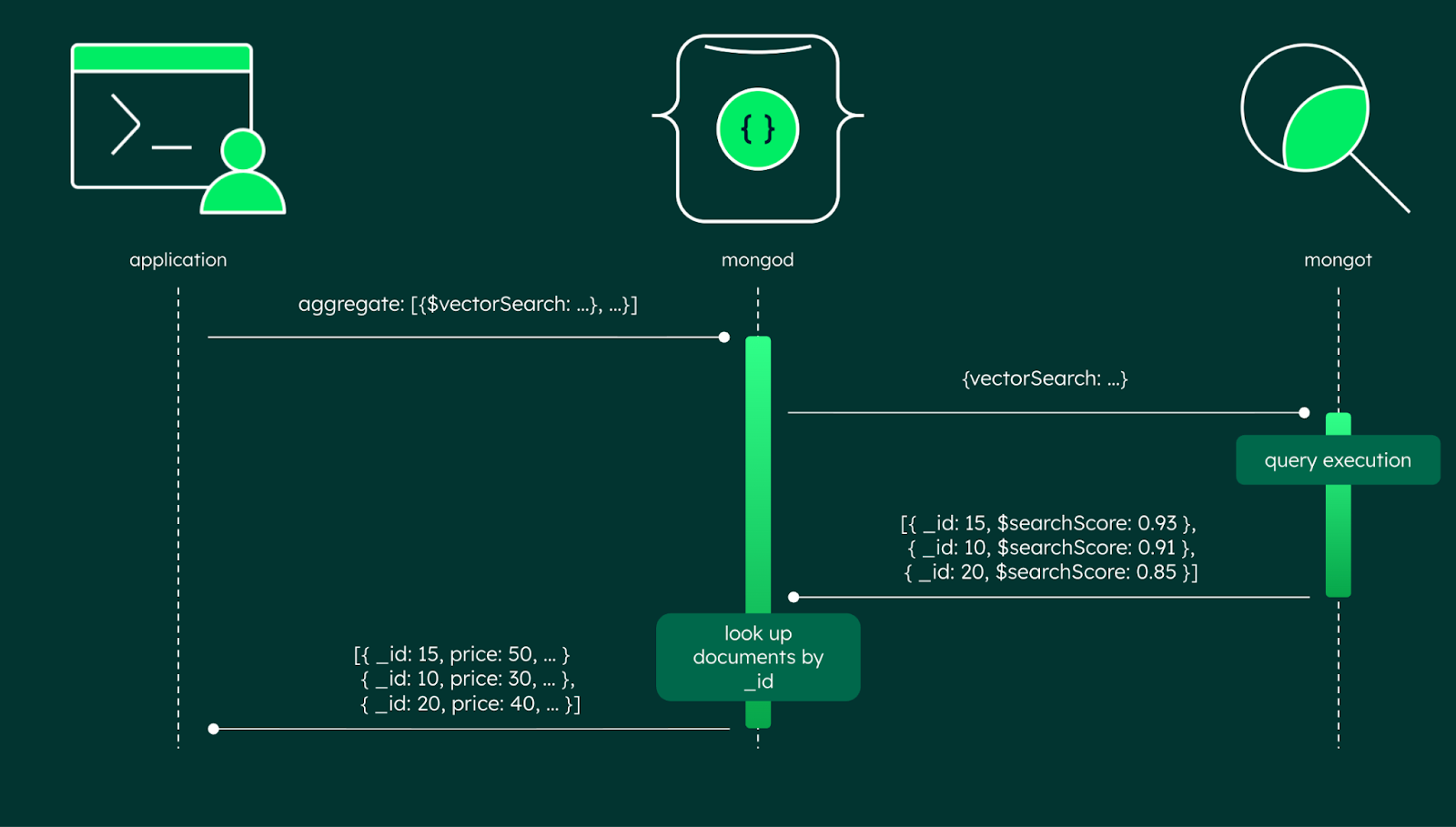
mongot can be run as a sidecar process on the same machine as mongod for ease of deployment and to share resources, or a set of mongot processes can be deployed as a service behind a load balancer for resource isolation and decoupled scaling characteristics.
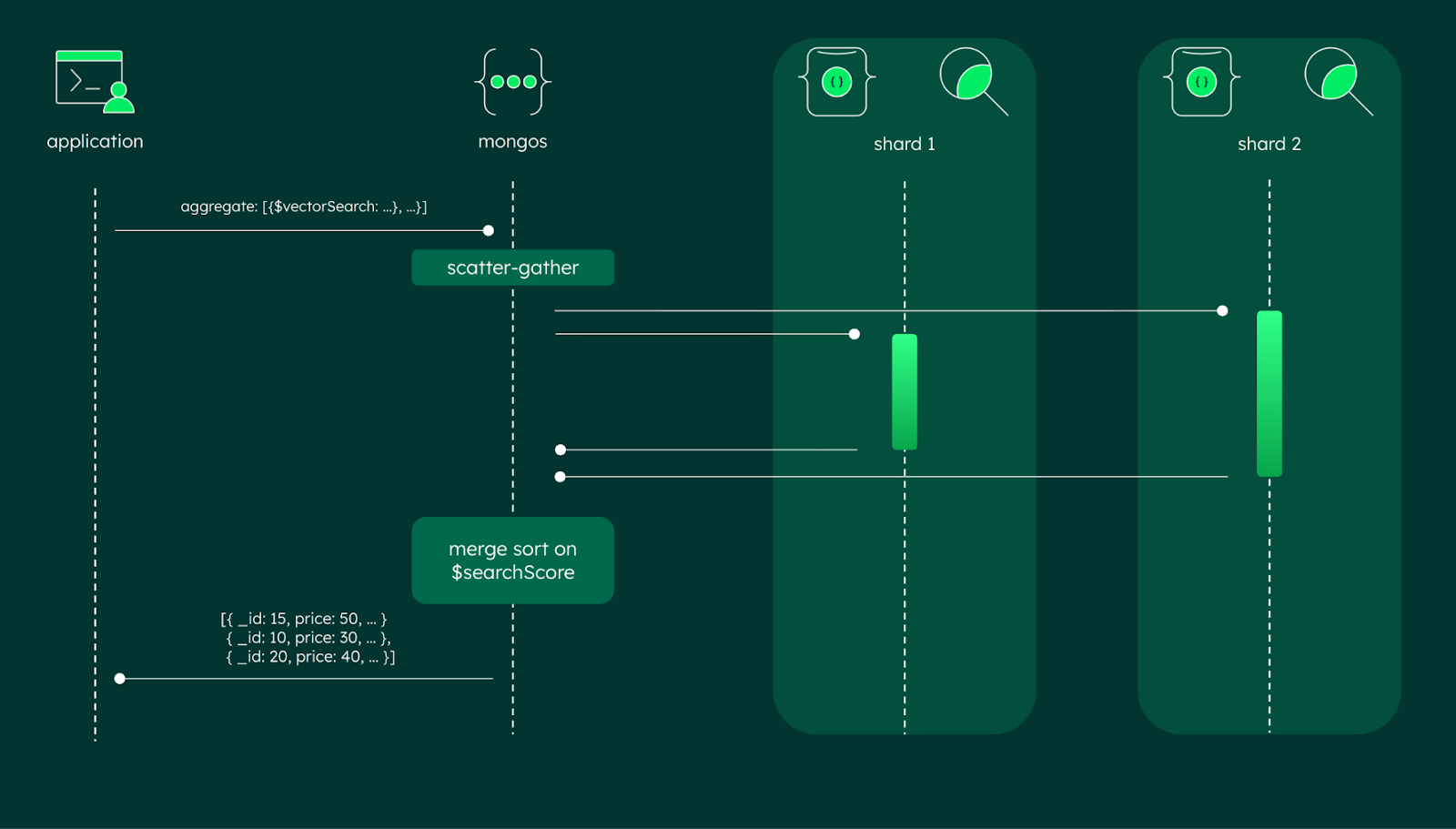
In a sharded cluster, search and vector search piggyback on the MongoDB sharding topology, acting as asynchronous local indexes for each shard. When mongos, the database router process also already available under SSPL, receives a $search, $searchMeta, or $vectorSearch query, it scatter-gathers these requests to the shards responsible for the relevant collection. The shards execute the queries in the same manner as described above, and stream the results to the router in order of $searchScore descending. The router merge-sorts the results on this field and returns them to the user.
What does mongot’s availability under SSPL mean for developers?
The SSPL is the same license governing MongoDB Community Edition. By making mongot source available, we’re bringing a key MongoDB technology closer to our developer community.
This release unlocks key benefits for engineering teams:
Unified platform: Run the same search and vector search capabilities across any environment, whether MongoDB Atlas, on-premise, or hybrid.
Deep auditability & debugging: For sensitive workloads, inspect the source code to fully understand how queries are executed.
Build flexibility: Build mongot from source to fit specific environmental constraints.
MongoDB best practices: Application developers can inspect the mongot code base to learn how to best architect highly scalable, data-intensive applications that use MongoDB.
Looking ahead
Today’s release is a public preview. By moving mongot to SSPL, we are sharing the code for transparency, inspection, and feedback, while laying the foundation for parity in the search experience across MongoDB Community and MongoDB Atlas. Stay tuned for more updates over the coming months.
Next Steps
Ready to explore mongot? View the source code on Github.