Driven by shifts in traveler behavior across the globe, airline loyalty is undergoing a profound transformation. Travelers now expect better digital services from airlines. Retailers, streaming platforms, mobility apps, and financial services applications have raised expectations for what a personalized, easy, and meaningful experience should feel like. Those expectations are also carried over into the travel industry.
Due to this change, the loyalty models of airlines, in which customers earn miles, accumulate statuses, and redeem points, no longer feel like enough. Customers want value throughout their journey, not just before and after the flight. They also expect a consistent experience across digital channels, and they compare airlines to the mobile apps and ecosystems they use daily.
Airlines today operate like retailers as they compete for attention in a crowded digital landscape. To show relevance, they require a modern data strategy that is flexible, data-driven and able to adapt to customer behavior. Traditional monolithic systems were not built for that level of responsiveness.
Digital transformation is no longer theoretical; the airline industry is leaning into it. An October 2025 Boston Consulting Group paper shows that “between 2025 and 2027, the value generated by using digital technologies” by airlines “is likely to more than quadruple.” This data reinforces a reality for most airline teams: the industry is changing quickly, and loyalty is a key area for meaningful impact.
Challenges airlines face today
Airline loyalty programs are among the most used in the world, yet traveler engagement has been declining. A paper published by Braze notes that although the industry is set to skyrocket in 2025, loyalty programs have become stagnant.
One of the biggest obstacles for loyalty programs is fragmented data, in which airlines often manage customer information across several disconnected systems, booking engines, loyalty platforms, mobile applications, call centers, and partner systems. Each one works independently. Without a shared, real-time understanding of the customer, personalization becomes difficult. Offers arrive too late, recommendations feel generic, and travelers no longer feel recognized.
Younger travelers notice this issue even more. They evaluate brands based on the usefulness and convenience they immediately receive. Flexible rules, transparency, and immediate acknowledgment matter more than traditional status. Loyalty must respond to their needs quickly, or interest fades.
Outdated technology behind many airline operations limits progress because it was not designed for real-time synchronization or rapid experimentation. In some airlines, it takes months every year to display a new status in customer mobile apps. Adding new partners or loyalty features can involve long projects with operational risks. As a result, innovation cycles slow down, and airlines struggle to keep pace with digital expectations.
Regulations add another layer of complexity. Airlines must navigate different data privacy and residency rules across regions, which hinders modernization, especially when data lives in systems not designed for multi-region compliance.
Meanwhile, competition continues to evolve; for example, low-cost carriers use simple loyalty structures to attract cost-conscious travelers. Retailers, hospitality groups, and fintech companies introduce new loyalty ecosystems that customers use daily. Sustainability-motivated travelers look for brands that commit to environmental and social goals. These elements pressure airlines to rethink how loyalty should work.
Together, these challenges show that loyalty needs to become more flexible, more connected, and more relevant to everyday life.
Rethinking loyalty architecture: From programs to ecosystems
The evolution of loyalty heads toward ecosystems that evolve with the traveler. Customers want benefits that go beyond the flight, and value experiences that connect to other aspects of their lives. Retailers and lifestyle companies have shown that partnerships boost engagement by offering value in more places.
For airlines, this means broadening loyalty beyond miles and seats. Travelers already spend time and money on dining, transportation, entertainment, tours, and financial services. A May 2025 white paper shows that “in 2024, the number of brands that have added travel rewards to their loyalty program surged to 95% (from 65% in 2022).” This illustrates how quickly cross-industry collaboration is expanding.
To support this ecosystem, personalization must be real-time and data-driven. Airlines must gather signals from multiple sources, including bookings, check-ins, and mobile interactions, to deliver relevant recommendations. And these recommendations must be consistent across all customer touchpoints.
This personalization requires a modern architectural foundation. MACH principles, microservices, API-first integration, cloud-native deployment, and headless experiences offer the flexibility to evolve loyalty without disrupting operations. Microservices let airlines improve small features without impacting the entire system. APIs simplify the integration of new partners. Cloud-native infrastructure provides the elasticity for fluctuating travel demand. Headless designs help digital teams update experiences more quickly.
How MongoDB enables the future of airline loyalty
MongoDB provides a data platform that supports this loyalty landscape for airlines, because its architecture unifies customer profiles, booking histories, payment details, loyalty activity, and partner data, into a single, consistent data foundation.
The flexibility of the document model is useful for loyalty programs, where rules, benefits, and partner offerings change frequently. With MongoDB, airlines can integrate new features and updates without long schema migrations or complex rework, reducing operational risk.
Capabilities like MongoDB Atlas Search and Vector Search further enhance personalization. These tools support contextual recommendations and AI-driven insights that instantly respond to traveler behavior. For example, they can enable smarter upgrades, tailored partner offers, or dynamic travel bundles that fit each customer.
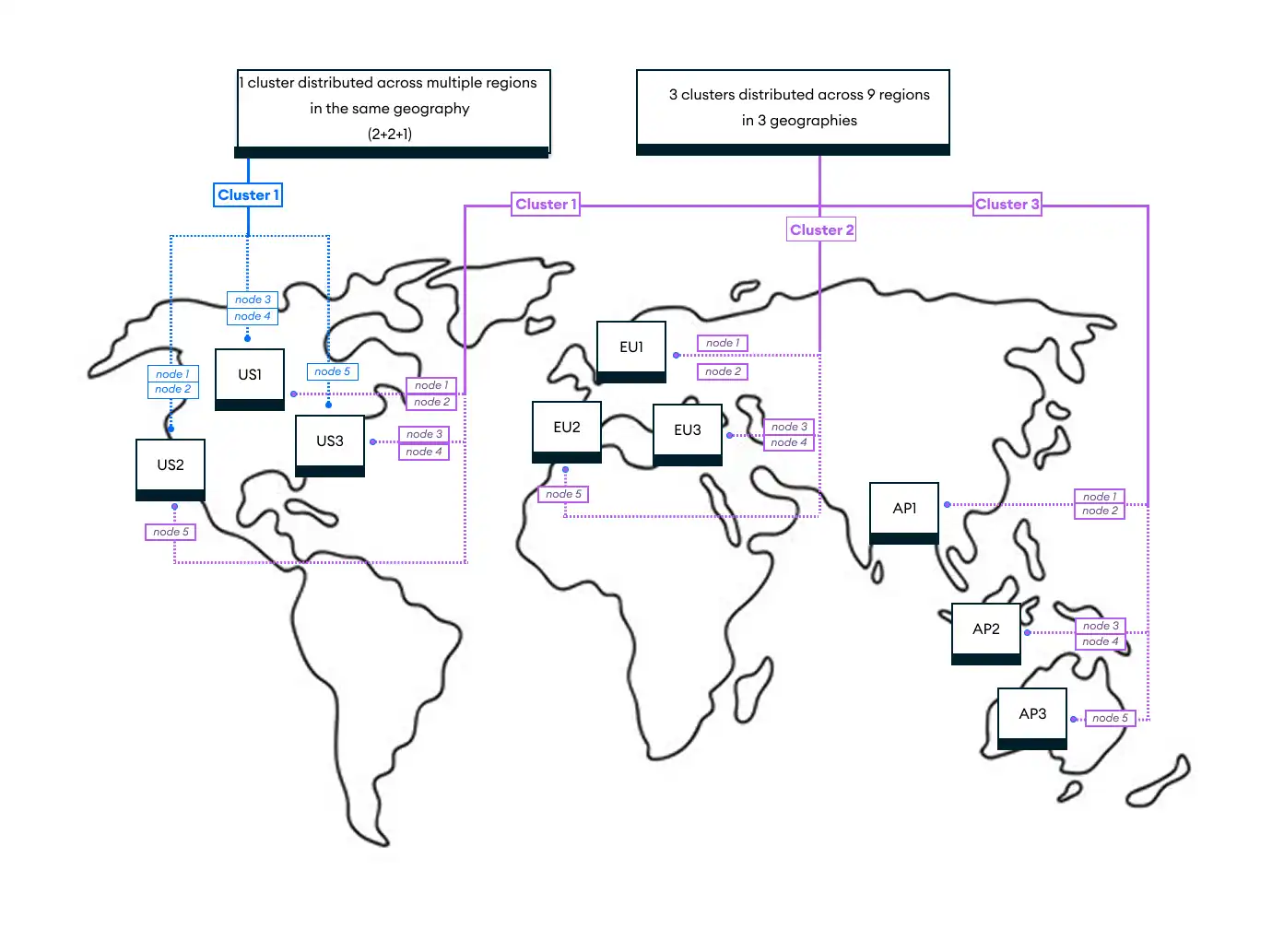
MongoDB’s distributed architecture is another advantage. Airlines operating across multiple regions must comply with local data residency requirements, which can be difficult with systems not designed for distributed workloads. MongoDB supports multi-region deployments and unified analytics, helping carriers stay compliant without sacrificing visibility.
Figure 1. Diagram using a 2+2+1 topology with MongoDB.
The strategic path forward
A structured roadmap provides airlines with clear steps for loyalty modernization, helping them move from transactional loyalty programs to dynamic ecosystems that strengthen brand affinity and revenue growth.
The first step is to modernize the data foundation by unifying customer, booking, and loyalty data into a single platform that eliminates fragmentation. A unified data layer provides the visibility required for personalization, operational optimization, and predictive insights. This concept is not exclusive to airlines; in our unified namespace blog, we implement this approach to manufacturing.
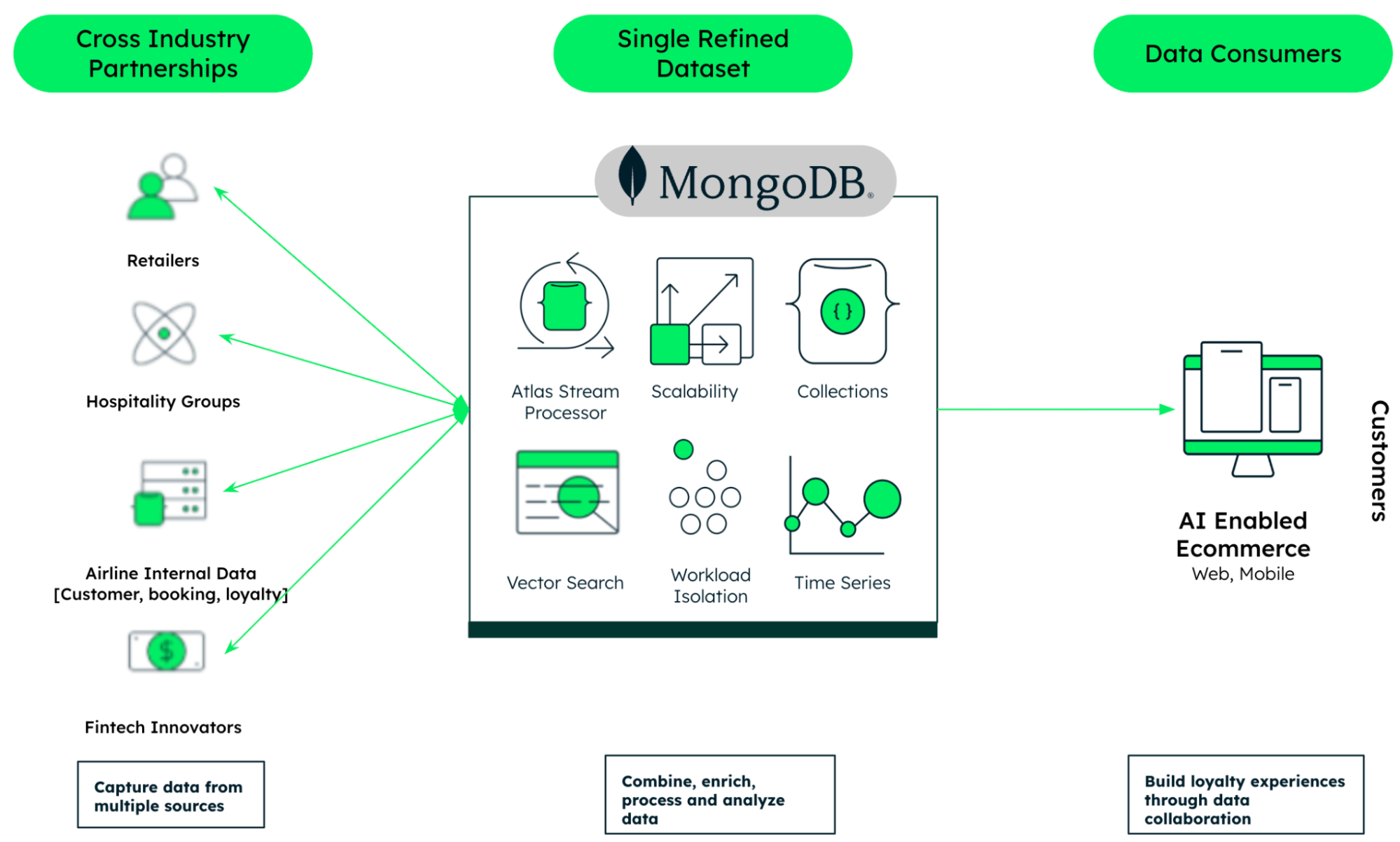
The second step is to adopt composable design principles, transitioning from monolithic platforms to microservices. These principles enable airlines to scale components independently, integrate third-party services more easily, and accelerate innovation. Composable architectures let airlines add or modify loyalty features without disrupting operations. MongoDB is an active member of the MACH Alliance, a non-profit organization that promotes composable architecture principles. As a result, you can use MongoDB to build MACH-based applications. The third step is to build loyalty experiences through data collaboration, activating real-time insights, and extending value through cross-industry partnerships that enrich customer engagement. This includes connecting with retailers, hospitality groups, fintech innovators, and mobility providers to create a broader ecosystem of rewards and experiences.
The final step is to measure engagement ROI through unified analytics. By consolidating operational and behavioral data, airlines can evaluate retention uplift, booking frequency, customer satisfaction, and loyalty programs’ cost efficiency. These insights allow IT and business leaders to iterate rapidly, refine offers, and align loyalty investments with measurable business outcomes.
Figure 2. Data integration across sources for loyalty programs.
Next Steps
The airline industry is entering a phase where loyalty must be reimagined. Travelers expect brands to understand them, offer value in real time, and connect with their daily habits, not just their trips. Meeting these expectations requires modern technology, strong data foundations, and partnerships that extend beyond aviation.
Composable architectures and real-time intelligence give airlines the ability to provide loyalty experiences that feel personal and consistent. MongoDB plays an important role by offering the unified data platform and flexibility needed to support this transformation.
The future of loyalty belongs to airlines that adapt quickly, collaborate broadly, and design relevant experiences for modern travelers. Airlines that choose this direction will build stronger customer relationships and create new growth opportunities in a digital world.
Next Steps
To learn more about MongoDB’s role in the airline industry, please check out our stories with Cathay Pacific and Amadeus. And to learn how to transform flight operations with real-time analytics, please check out our post on building a flight management solution.